Looking Back 10 years to See Today
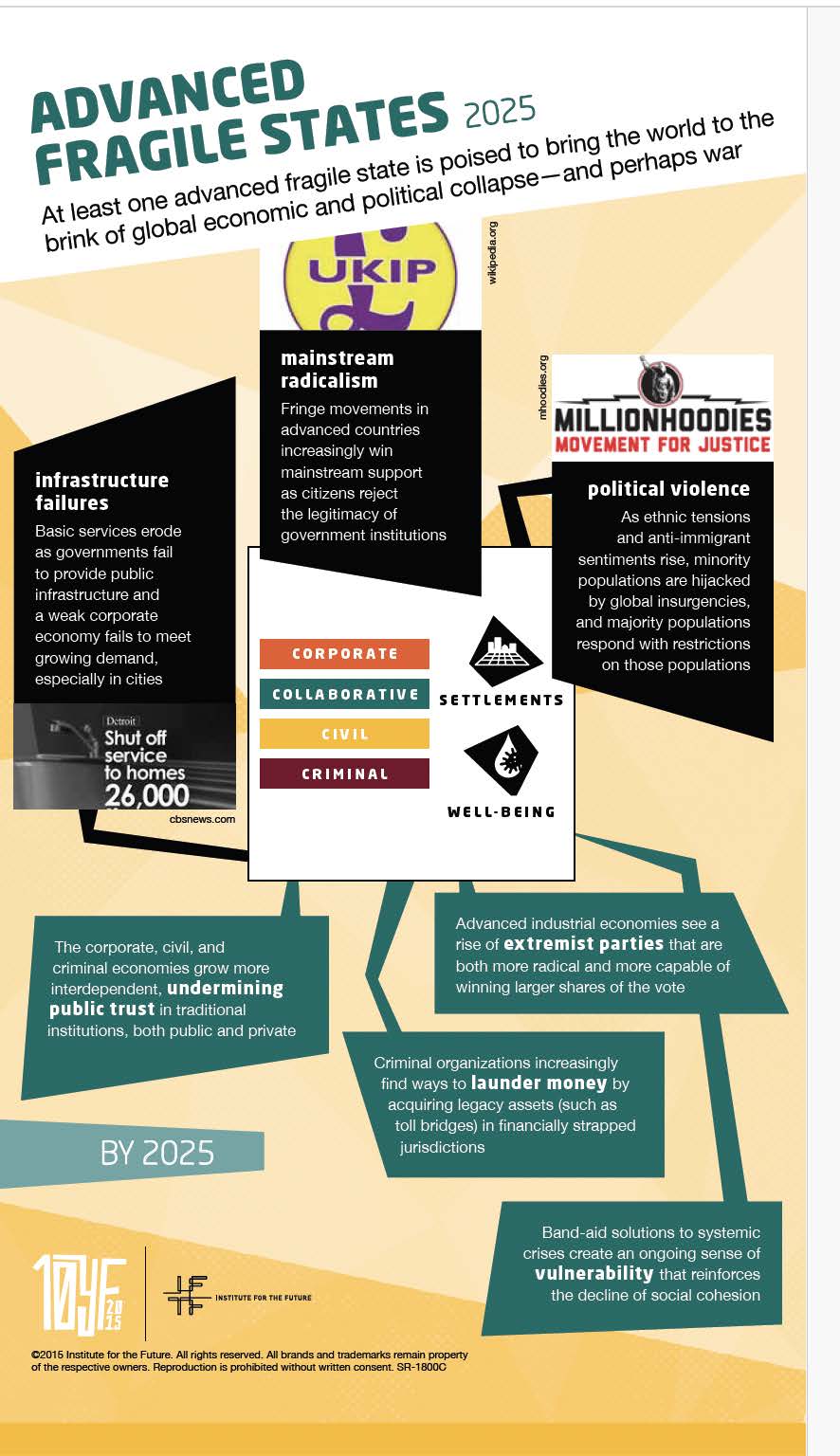
“At least one fragile state is poised to bring the world to the brink of global and economic political collapse—and perhaps war,” reads the Institute for the Future’s 2015 forecast. Underneath the core story, several sub-stories are spelled out: mainstreaming of radicalism, major infrastructure failures, and rising levels of political violence largely directed at immigrant and minority groups. Our Ten-Year Forecast, something we’ve been releasing every year for the last forty years, has come to unfortunate fruition a decade later and it looks like that country is the US!
I take no pleasure in being right or claim any prescient ability to see the future. My colleagues and I always say that we don’t predict the future and that no one can predict the future. This is something we learned over almost six decades of the Institute’s existence. In the past few years, however, it seems that the direst of our forecasts have been turning into reality with alarming frequency—a large scale respiratory pandemic, an internal cold civil war, extreme and widespread anti-immigrant sentiment. I recently heard Cory Doctorow, a science fiction writer and frequent collaborator, lament that Elon Musk and his fellow tech billionaires have misinterpreted dystopian science fiction as business plans. Instead of viewing his writings as cautionary tales to guard against, they set them as goals to actualize. I feel the same about our bleakest forecasts.
What were we seeing ten years ago that led us to the 2025 scenario and what are we looking at today as we are trying to imagine 2035? Since there is no data about the future, some of the main tools for envisioning potential futures is history and signals. Mark Twain famously said, history does not repeat itself, but it does rhyme. There are patterns in history that tend to repeat over and over, which is why when thinking about the future it is essential to understand the past—how did we get here? What are the patterns of the past that help us make sense of where we are today? What clues do they give us as to what could happen next? And if there is one glaring warning sign we saw in the US 10 years ago, it is extreme and growing wealth inequality. Extreme inequality is a problem not only because it violates innate human sense of fairness and fair play but more importantly because it destabilizes society on many levels. It breaks webs of connections between fellow citizens who no longer inhabit same social and physical spaces and who literally live in different realities. Indicators of social fracture are all around us, not just in incomes data but in data on life expectancy, health access, education levels, political preferences, media choices, ownership of basic assets like homes and retirement savings. Wealth inequality results in high levels of stress and low levels of trust between different groups and in basic institutions. Complexity scientist Peter Turchin has been tracking 30 different social indicators going back hundreds of years in societies as diverse as the Roman Empire, Imperial China, medieval Europe, and the US. He writes, “Complex human societies, including our own, are fragile. They are held together by an invisible web of mutual trust and social cooperation. This web can fray easily, resulting in a wave of political instability, internal conflict and, sometimes, outright social collapse.”
History is an essential but not sufficient tool for a futurist. History is not destiny after all, it can take twists and turns. This is why the other tool we turn to is “signals.” We define signals as small or local innovations or disruptions that may appear on the margins but have the potential to grow in scale and geographic distribution. In other words, today’s signals might combine into larger trends or forces shaping society tomorrow. And one big signal we were seeing, thanks to two of our Future4Good Fellows and founders of a global investigative journalism network OCCRP, Paul Radu and Drew Sullivan, was the growth of the global economy of crime and corruption. This was revealed in Panama Papers– a massive cache of 11.5 million records leaked from the law firm Mossack Fonseca – documenting how several heads of state have been sheltering their personal wealth in offshore accounts to evade taxes. While dictators are known for draining public coffers and hoarding the ill-gotten funds in secret accounts, what Panama papers and subsequent investigations have continued to reveal is pervasiveness of illicit flows of corrupt money and influence, involving not only criminals but global businesses, civic leaders, philanthropists, and various service providers—law firms, consultants, middlemen. Spurred by globalization, free flow of capital, and dissolution of the Soviet Union, experts estimate the illicit economy to add up to about $30 trillion (probably an underestimate), close to the total US GDP. These two horsemen of state fragility—inequality and corruption—is what led us to the 2015 forecast.
Where does it leave us today? What signals are we looking at? It is not an understatement to say that right now at the federal level we are witnessing the gutting of the infrastructure for fighting corruption internally in the US and globally. Such efforts include pausing investigations into corporate foreign bribery, abandoning enforcement of a foreign agent registration law, and curtailing of criminal prosecutions of Russian oligarchs, just to name a few. They open doors to greater levels of corruption and flourishing of oligarchic networks. Combined with reductions in public support for education, health and other benefits, it is likely that wealth inequality will only get wider.
Given the signals, it is easy to forecast some form of a social collapse. In fact, many collapse scenarios are being written today. They echo different historical precedents—fall of the Roman empire, rise of fascism in the 1930’s Germany, stock market crash in the US in the 1920’s. In reality, no one can predict what such collapse might look like in today’s world or when exactly it might happen.
But 10 years is a long time. And today I try to look for signals that can give me hope. For those I look at what is happening on the ground in Los Angeles after the fires—people are coming together outside of formal institutions to coordinate food distribution, provide free meals, and deliver needed supplies in neighborhoods. GoFundMe donations for victims reached over $250 million, surpassing the combined number raised for natural disasters over the whole previous year. Natural disasters (which unfortunately are only likely to increase), wars (something I hope we can avoid), and other crises bring people together. They tend to unify societies as webs of relationships and mutual support networks grow. This is not surprising--societies with limited financial resources and weak institutional infrastructures develop robust informal economies in which relationships and mutual support networks serve to fill the gap. While many economists dismiss such informal economies as inefficient or marginal, these are the kinds of social arrangements humanity has engaged in for most of our history. Mutual aid practices and the mutualist ideology behind them did not originate in business schools and economics departments. This is how people have and are managing to survive for millennia.
I expect and hope that in the next ten years as we are likely to experience more crises– political, economic, environmental--we will increasingly start practicing mutualism—coming together of necessity to repair our social fabric, in the process developing new norms, values, and practices. In biology, mutualism refers to a symbiotic relationship between two organisms from different species that benefits both. At a societal level, mutualism involves recognition that the social and economic well-being of any individual is highly dependent on the well-being of others in the society. For decades we did our best to marginalize mutualism. Our policies, institutions, tax, and regulatory systems are based on what can be best described as the anti-mutualist agenda. I can’t imagine how we will be able to survive and thrive in the next ten years without changing this trajectory.
While we can see signals of mutuality on the ground, the other signal to look at is the number of books, articles, and initiatives questioning neoliberalism and offering alternatives. Yes, these efforts might be on a retreat at this moment, but they don’t go away. Milton Friedman famously said, “Only a crisis - actual or perceived - produces real change. When that crisis occurs, the actions that are taken depend on the ideas that are lying around. That, I believe, is our basic function: to develop alternatives to existing policies, to keep them alive and available until the politically impossible becomes the politically inevitable.” Indeed, we have a lot of ideas on alternatives lying around waiting for the right moment. They haven’t yet coalesced into anything resembling Project 2025 but we have 10 years to imagine and write Project 2035, which looks very different.